top of page


Welcome to the Archangel Diocese


✠
LITURGICAL SPACE
The Sacred Order of the Temple and the Manifestation of Heaven on Earth
I. Introduction: The Church as the House of God
The Orthodox temple is not a gathering hall, nor a symbolic structure, nor a place defined by human architecture alone. It is the House of God, the dwelling of His glory, the place where heaven and earth meet. Every part of the church — from the narthex to the altar — is arranged according to ancient Tradition, revealing the order of the Kingdom and the mystery of salvation.
The liturgical space is not accidental. It is theological.
II. The Threefold Structure of the Temple
1. The Narthex: The Place of Preparation
The narthex is the threshold of the holy place. Historically, it was the area for catechumens, penitents, and those preparing to enter the mysteries. It symbolizes:
-
The beginning of repentance
-
The first steps toward illumination
-
The transition from the world to the Kingdom
Even today, the narthex remains a place of recollection, candle-lighting, and spiritual preparation.
2. The Nave: The Assembly of the Faithful
The nave is where the faithful stand as the People of God. It represents:
-
The Church militant
-
The pilgrim people journeying toward salvation
-
The unity of the faithful gathered around Christ
The nave is not a place for casual conversation or distraction. It is the place where the faithful stand before the Lord, participating in the sacred mysteries.
3. The Sanctuary: The Holy of Holies
The sanctuary — also called the altar — is the most sacred part of the temple. It symbolizes:
-
Heaven itself
-
The throne of God
-
The place where Christ offers Himself for the life of the world
Only the clergy enter the sanctuary, not by human privilege, but by divine calling. The sanctuary is veiled, elevated, and set apart, revealing the holiness of God.
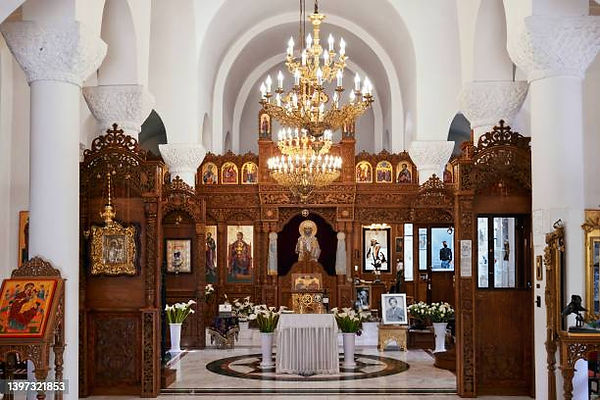
III. The Iconostasis: The Gate of Mystery
The iconostasis is not a barrier but a revelation. It shows:
-
The union of heaven and earth
-
The presence of Christ, the Theotokos, and the saints
-
The mystery of the Incarnation
The royal doors signify the entrance of Christ into the world. The deacon’s doors signify the ministry of the angels. The icons proclaim the Gospel visually, teaching the faithful through sacred beauty.
IV. The Altar and Its Sacred Appointments
1. The Holy Table
The altar is the throne of Christ. Upon it rests:
-
The Gospel Book
-
The Cross
-
The Antimension
-
The Holy Gifts
The altar is consecrated with holy chrism and relics, making it a living witness of the martyrs.
2. The Prothesis
The prothesis is the place of preparation, where the priest offers the bread and wine before the Divine Liturgy. It symbolizes:
-
Bethlehem, where Christ was born
-
Golgotha, where He was offered
-
The hidden work of grace
3. Sacred Vessels and Appointments
The chalice, diskos, star, spear, and veils are not mere objects. They are instruments of the mysteries, treated with reverence and handled with prayer.
V. The Liturgical Movement Within the Space
The clergy do not move randomly. Every action is ordered:
-
The Great Entrance reveals Christ going to His voluntary Passion
-
The Little Entrance reveals the coming of the Gospel into the world
-
The censing reveals the prayers of the saints ascending to God
-
The processions reveal the Church’s journey toward the Kingdom
Liturgical movement is theology in motion.
VI. The Sacred Silence and Reverence of the Temple
The liturgical space demands:
-
Silence
-
Attention
-
Reverence
-
Modesty
-
Prayer
The church is not a social hall. It is a place where the faithful stand before the living God. Every gesture, every word, every moment is offered in worship.
VII. The Church as Heaven on Earth
The Orthodox temple is a microcosm of the Kingdom:
-
The sanctuary reveals heaven
-
The nave reveals the Church militant
-
The narthex reveals the beginning of salvation
-
The iconostasis reveals the saints
-
The altar reveals Christ
To enter the church is to enter the mystery of salvation.
VIII. Conclusion: The Liturgical Space as a Revelation of God
The liturgical space is not human invention. It is divine revelation, preserved through centuries of Tradition. It teaches the faithful how to pray, how to stand, how to worship, and how to behold the glory of God.
To honor the liturgical space is to honor Christ. To preserve its order is to preserve the faith. To enter it with reverence is to enter the Kingdom.
✠

bottom of page